Wednesday, February 23, 2011
The Most Amazing "Veggie Burger"
So for lunch on tuesday my Host Mother made me a "veggie burger" to take with me to school. It was actually an accident, but it was simply amazing. My mom combined Chunks, which is kinda like tofu, and made of soy and beans, I guess, I dont really know. It has a very weird consistency, a very meat like consistency actually. Anyways, she combined the chunks with some sort of fish and ground it up to form a paste like mixture. She then mixed that with some breadcrumbs and seasonings and fried it. Everything is fried here. After the veggie/fish patties were prepared and cooked, they were cooled and put on bread with lettuce, tomato, onion, mayo (mayo is on everything) and ketchup. Alas, a Caribbean style veggie burger. Unfortunately, I forgot to take a picture this time. But hopefully she will make them for me again soon and teach me how to make them!

Sunday, February 20, 2011
Life in SVG
So aside from the details about training sessions so much else has been going on. I have been spending the weekends with my host family. So far, my host sister has been taking me on a drive along the Windward HWY and the Leeward HWY. We stopped at a few key spots along the way on each.
The first weekend, we drove along the coast on the Windward (east) HWY up to Owia to the Salt Ponds. We stopped at Black Point, a national park, where I got to see a black sand beach, an old tunnel used for sugar exportation, and some amazing views. We continued north along the HWY, which is really nothing more than a narrow road, through Biabou, Georgetown, and Sandy Bay to Owia. We passed the palm tree forest, crossed the Dry River, passed La Soufriere, the volcano, and on the way saw some really spectacular views of the coast and mountainous terrain. We concluded at the Salt Ponds, which is a natural cove of water sheltered from the usually harsh winds/currents/waves on the east coast by volcanic rocks.
This weekend, I did some exploring with a fellow volunteer who lives fairly close to me, only about 20 minutes walk (hike). We went for a walk along a nameless road (though technically called the Vigie HWY), through Yambou, to where the road met the Windward HWY. Once we reached the HWY we wandered around until we stumbled upon Argyle Beach. It was pretty, but completely covered in trash, mostly plastics. We attempted to send a message in a bottle, but it didn’t quite work out.
On Sunday, my host sister, Allyson and her BF, Claude, took me for a drive along the Leeward HWY. To get to the Leeward HWY we had to travel from Mespo to Kingstown and then up. We stopped at the Layou Petroglyphs, continued north through Barrouallie, saw part of the largest coconut farm, to Wallilabou, the site for the filming of the Pirates of the Caribbean. The Leeward side of the island is much more mountainous and cliffy. At some points along the coast the Pitons in St Lucia are visible. The HWY must follow the mountains, as there is no way to go around them. Consequently, the roads are even narrower than on the Windward side, and much more steep, with many hairpin turns. It was a bit scary. And by a bit, I mean really scary! It was worth it though because the views were absolutely breathtaking. We continued northward to Chateaubelair, and beyond where we stopped at Dark View Falls. This was one of the most spectacular waterfalls I have ever seen. To get to the falls we had to cross another nameless river, over a bamboo suspension bridge! It was the coolest bridge I have ever seen. The bamboo here was HUGE. After the falls, we continued north to Richmond, where La Soufriere was looming in the distance, where the road pretty much ended and we had to do some offroading. We turned around shortly thereafter.
SVG is beautiful, but really beautiful is an understatement. I wish I had the vocabulary and ability to accurately describe in words how amazingly beautiful this place truly is. But alas, I am no English major. Sorry, youll have to look at the pictures to get a sense, even though they don’t do it justice. Everything is so vibrant, green, and lush. Kingstown is a bit of a concrete jungle, but that is to be expected of any country’s capital, or major city. Other than Kingstown everything is so green and full of life. I have never seen so much foliage. There are banana trees/crop, palm trees/coconut trees, mango trees, nutmeg trees, almond trees, breadfruit trees, sour sop bushes, I could go on if I knew the names but I don’t.
I actually live in Mesopotamia, however it is referred to as Mespo. Which is kind of ironic since the undergrad materials science and engineering academic club at Drexel was called MESPO. Anyways, Mespo is in the Marriaqua Valley or the Mesopotamia Valley. I am completely surrounded by Mountains and Rivers. At the end of my street (which doesn’t have a name), I live on the main street that runs through Mespo and northward toward Richland Park, two rivers (which also have no name) unite. Literally on either side of the road is a river. There is a T junction, or a Y Junction. The T junction represents the streets, and the Y represents the Rivers, now place them on top of one another and that’s what the intersection looks like. The street is narrow, winding, and relatively flat, since I am at the bottom of the valley. I can walk about 45 minutes to 1 hour and reach the Windward “HWY” and the ocean. I have no sea views and it frequently rains. The rains are incredibly intense but only last a few minutes, usually.
My Host Family’s house is HUGE. It is a 3 story building with a grocery store on the first floor, the main living area on the second which is accompanied by a huge veranda that wraps around half of the house. There are 4 bedrooms, a computer room/office, 4 bathrooms which all have large spa like tubs, a kitchen that has granite counter tops, two ovens, two stoves and so many cabinets! There is a formal living area, which no one uses, but it is very grand. There is also a formal dining area attached to the kitchen with 8 high back elaborately carved wooden chairs. The entire living area is open with grand vaulted ceilings that rise about 30 feet. On the first floor, there is also another entire apartment, with a library/tool room, bathroom, living room, and god knows what else behind the closed doors. Then there is the basement, which has a bathroom, bedroom, and the laundry area. There is wash machine, but clothes are hung on a line outside in a covered patio to dry.
There are 6 pigs in the backyard, about 80? chickens used for eggs, a number of dogs, and they have a greenhouse type set up, but it is not used because my Host Mom doesn’t have enough time to garden. Behind the garden is the/a river and a nutmeg tree (I think?).
The area is pretty busy, since I live on the main (and only road thru my village and connecting to nearby villages), and my room is in the front of the house. I hear all of the traffic, which drives so fast, and all the sound systems blaring, horns, etc. In addition to that, I am frequently awoken by church bells at 6am on Saturday/Sunday mornings and all the neighborhood dogs howling in unison. Then there are the roosters, and the general traffic/loitering caused by the store.
Kingstown is surprisingly a lot cleaner than I was expecting it to be, too. Sure there is some garbage in the streets, but on the whole, Kingstown is much cleaner than other cities I have been to, even in the United States. I have seen people cleaning the street gutters, and I imagine this is very necessary because I have yet to find a public trash can.
Some general observations and things to point out. Everyone that I have seen riding a bike is also wearing a helmet! YAY! Even those who are riding motorcycles wear helmets! There are no stop lights, wait, I have seen one, but it was not in operation. There are very few traffic signs, and I have not seen a speed limit. There is a very distinct dialect, which might as well be another language. Everyone speaks so fast, so if there was any hope of me understanding anything, it is hopeless. Unfortunately we are not taught the dialect during PC Training, so we are left to just pick it up ourselves.
Vincentians LOVE mayonnaise, butter/oil, sugar, and salt. One or all of those ingredients can be found in pretty much everything, and in excess too! Im probably going to develop diabetes, hypertension, and get really fat. Gah! They also love juice. But their juice is the equivalent of our Koolaid, but with twice as much sugar. The oranges are green. Everyone spells my name correctly for once. They also say it very prettily. My last name in the local dialect sounds similar to the word for “get your ass out of the way”. It is very difficult for people to understand what I am saying when I tell them my last name. Deet is my new perfume.
Technicalities
I know its been a while since I posted a detailed update about what has been going on in my life. So here it goes.
For the first week we were required to be in Kingstown every day around 830am until about 4pm for training sessions. In the beginning of the week we had a lot of introductory sessions. We were introduced to some key trainers. Provided yet more paperwork to be filled out and handed in. We played a lot of ice-breaker type things and just general introductions of ourselves to the new trainers. We had various training sessions that covered topics ranging from service learning, technical training focused around youth development and institutional development, such as project planning; cultural training and integrating into the community, the importance of journaling everything (which I am not too good at), and PACA training, and that is just to name a few! PACA is participatory analysis for community action. As part of PACA training, we discussed the significance of perspectives and using filters to view things. Additionally, we learned the importance of observation, especially as a new person to the country/community. We set up bank accounts at a local bank, so when we get “paid” we have a safe place to put our limited money. We also got cell phones! However, there were some technical difficulties and it took a while before we got our phone. But we are all up and running now. The phone is similar to my very first cell phone, in the sense that it has very limited capabilities, but it is significantly smaller.
We had a very brief introduction into the history and culture of SVG. Didn’t learn too much more than I found myself on Wikipedia, at least so far. Next our IPP (institutional point person), the person we will be working directly with at the school or NGO we have been placed with came to talk to us about our assignments. My IPP is Shara, who is the Literacy Coordinator/teacher at EHSM. She is very young, a trained teacher from the Technical College (kind of like a community college) and full of life. I am looking forward to working with her. We got to chat for a while about the school, what her role is, what my role will be, any expectations, a little bit about the students and how things are run and so forth. More on my School Attachment later, for sure.
We had a lesson on the educational system in SVG. Most schools in SVG are government schools, with very few private schools. The govt plans, funds, and manages the school system. We learned about the education system hierarchy; the Minister of Education deals more with policy and allocating resources, determining the curriculum, and the Chief Education Officer deals more directly with the schools. There are primary schools, equivalent to elementary schools in the States, and secondary schools, in likeness to middle and high school. One striking difference between the US and SVG is the CEE or common entrance exam. The score of the CEE determines where the student will go to school-the govt places the student at a particular school based on the score of the CEE. In by doing so, the schools are therefore divided based on abilities; with a higher concentration of “better” students at one school, and “weaker” students at another school. This, in my opinion, causes many problems. For example, the “less equal” schools do not receive as many resources, or as many trained teachers so there is fierce competition to get into the “more equal” schools. That’s another thing, some of the teachers I am working with are 19 years old! And the teachers do not have to be formally trained to teach. The curriculum is based around the National Exams. After secondary school comes tertiary, or pre-university, also called college. It is similar to community college and the programs are only 2 years. College is divided into four divisions; arts, sciences, general studies (prepares for university); teacher education (to become teachers); technical education (plumbers, electricians, etc); nursing education (to become nurses). Essentially, the education system is very centralized, competitive for good placements, and focused on passing exams. In general, there are major literacy problems, difficulty to get students to focus, increased school violence, limited resources, and male underachievement.
An SVG police officer came to speak to us about safety and security within the country. He was very informative. The country as a whole places a high emphasis on respect and dressing professionally, and this is critical to our successful integration. We also had a panel discussion about the youth environment in SVG from a school principal and a new (19 year old) teacher. This was helpful, because we got two different perspectives on the outlook towards youth.
So, for the most part, we talked a lot about working in and with schools. This included good/bad practices to be effective, classroom management, strategies for teaching, establishing a safe classroom atmosphere, etc. We focused attention on PACA and service learning and incorporating this into working with the schools, and how to effectively plan projects. We had a brief introduction into literacy teaching. This was a little less than helpful for me, as it was focused more on the challenges to literacy and less on how to actually teach literacy.
Of course, there is an emphasis on reflection. For nearly all training sessions we have, we have a reflection time to discuss our thoughts and feelings. This has never been an interest for me. But I may have to learn to adopt a love for it, since we are constantly reflecting as a group. Reflection usually consists about talking about the feelings and the importance of forming meaningful relationships with our work counterparts, host families and community. There is a huge push for journaling and reflecting either as a group or individually.
We began going to our school attachments during week 2 of training. So from now on I will be going to Emmanuel High School Tuesdays and Thursdays, and continuing to go to Kingstown MWF for more technical and cultural training. Observing the school day on Tuesday was very interesting. It is nothing like middle/high school in the US. EHS consists of two buildings; the main building and the Annex, which are about 1/8 mile apart. Forms 1 and 2, grades 7 and 8, are in the Annex, which is where I will be spending most of my time, since that is where the literacy “room” and “library” are. Forms 3,4 and 5 are in the main building along with the principal and administration. The buildings are extremely cramped. There is barely enough space for all the students in the classrooms. There are no teacher desks in the classrooms, only enough space to shuffle in and out of the room and stand in front of class at the chalk board. Instead, the teachers share a room, appropriately called the staff room, where they have desks similar to the students. Moreover, the students remain in their classrooms and the teachers go to them as the classes/periods change. Periods are 35 minutes with an hour for lunch, the entire day running from 815m until 3pm.
We began going to our school attachments during week 2 of training. So from now on I will be going to Emmanuel High School Tuesdays and Thursdays, and continuing to go to Kingstown MWF for more technical and cultural training. Observing the school day on Tuesday was very interesting. It is nothing like middle/high school in the US. EHS consists of two buildings; the main building and the Annex, which are about 1/8 mile apart. Forms 1 and 2, grades 7 and 8, are in the Annex, which is where I will be spending most of my time, since that is where the literacy “room” and “library” are. Forms 3,4 and 5 are in the main building along with the principal and administration. The buildings are extremely cramped. There is barely enough space for all the students in the classrooms. There are no teacher desks in the classrooms, only enough space to shuffle in and out of the room and stand in front of class at the chalk board. Instead, the teachers share a room, appropriately called the staff room, where they have desks similar to the students. Moreover, the students remain in their classrooms and the teachers go to them as the classes/periods change. Periods are 35 minutes with an hour for lunch, the entire day running from 815m until 3pm.
The library is actually the size of a broom closet and is also the literacy room. There are some shelves lining on wall, which holds about 14 books that are all old and decrepit. Its not much of a library, but that’s why I am here! This will definitely be a challenge! On my first day observing, I followed Shara around, introduced myself to her classes, graded some spelling tests that she administered, met with the principal and discussed their expectations for me. We will see how this goes.
On my second day of observation, there was no school, but instead “Heats”. “Heats” is basically a mandatory track meet for all the students. All 700 of them, although I don’t think they all came, since some don’t actually like to run, and Heats was held at the Cricket field near the airport, close to town (about 45 minutes away from the school). The school does not provide transportation, so the students need to find their own way, usually the bus/van. Anyways, this was total chaos. Most of the students ran barefoot, which is very common, some ran in jeans, and it was the hottest day since I have arrived. There was not a cloud in the sky, subsequently I got some bad sunburn! Monday, February 14, 2011
Addendum to the Bus Experience
In case it wasn’t readily clear what the bus experience is truly like, let me give you some key words that I would use to describe it.
· Cut throato People push, throw elbows, and fight there way to get onto the bus. Considering they are basically minivans, they fill up pretty fast, and as I was saying earlier, there is no rhyme or reason as to when the next bus will come. So people will do anything to get on it.· Uncomfortableo This is an understatement.· Painfulo This is more accurate. Because they cram so many people in, there will be times when you are “sitting” (I put sitting in quotes because you are basically hanging on to the seat for dear life) next to some large person, and you may barely have half of one butt cheek on the seat. Then your knees are digging into the seat in front of you, or the metal support post, or you are being squished against some hard surface, from side to side at every turn. PAINFUL. I have bruises from riding the bus!· Workouto It’s a workout to try to keep yourself:--Balanced--Seated--Prevented from being flown out or from side to side· HOT o 20+ people in a minivan with limited air flow (or no air flow), sweating because its 85F and humid, wet because its been raining, etc. · Toxico Forgot to mention all the horrible horrible air pollutants that the vans dispel. Not only are they being expelled into the air, but are then being re-circulated inside the cabin of the van. Im probably shedding about 2 months off my life each time I get in a van; add up all the times I ride the bus and it could be years!· Rollercoastero Only not as fun, because youre riding the rollercoaster without being buckled in and secure. You are bouncing around, being ejected from your seat. Pretty intense roller coaster, and much cheaper than the amusement parks.· LOUDo Every van has a sweet sound system that is constantly blaring loud music. At the end of the day, I just want some peace and quiet, which is definitely not happening.
Sunday, February 13, 2011
The Bus Experience
This whole experience can be summarized as letting a mouse loose in a maze; I am the mouse, and the maze is the country of St Vincent; the goal is to find my way home safely via the bus system.
Step number one: Find the bus terminal. It was about 4pm after Day 1 of Phase II training ended at the Peace Corps office in Kingstown. My host mom had given me a very brief tour of the city after she picked me up from the Peace Corps office on Saturday when I arrived. She pointed it out, but between her dialect and all the new sights, sounds, smells and fatigue, it was a bit of a struggle to remember exactly where I was to get the bus. Luckily every one is extremely helpful.
So after training, another volunteer and I set out for the bus terminal together. In fact we all (~12 volunteers in all) set out to catch our bus back home, but at different times and different directions. I’m not quite sure how, but I think 75% of us ended up at the same terminal, but from completely different paths. Anyways, at first we went to the wrong bus terminal; there are two main terminals. One for buses that go to the Leeward (west) side of the island, and one that goes to the Windward (east) side of the island. The thing about buses in St Vincent, or any of the Caribbean islands, is that there is no set schedule. Buses just come and you just pile in, until you can fit no more bodies.
Step number two: Get on the correct bus. After finally making my way to the windward bus terminal, which happened to be in Little Tokyo, or the fish market, I needed to figure out which bus was the bus going in my direction. I asked a very kind woman who told me where to stand for my bus. The next major thing to point out is that buses here are not really buses. They are more like minivans. They aren’t labeled with the final destination or anything like that, but instead have sweet rims, or have different sayings painted on the front to represent the attitude of the driver or something else. For example, swagger, cash money, krunk, krank, respect with a backwards E, street wize, captain, dogg, bling bling, I could go on and on. So the best thing to do is just to ask where the bus is going. Luckily, my host sister, who drove me to the PC office this morning, quizzed me to see if I remembered where I lived so I could get back.
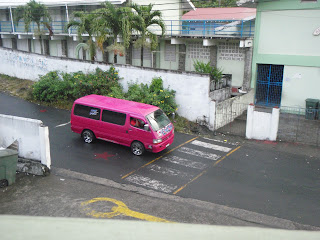


Some of the vans that run from Mespo to Town. Pink=Venom, Yellow=Fusion.

Step number three: Once on the bus, I wasn’t really sure how to let them know when I wanted to get out. I guess they just know. This seems to be a common theme among my fellow volunteers; we all have theories for how the conductor (the person who opens the van door, collects the money ($2.50 for me, which is about $1 US), and alerts the driver) lets the driver know. It took about a little over an hour to get home. All of the streets are narrow, but paved, and extremely winding and steep. It’s a wonder there aren’t more accidents. In fact, from what I hear, accidents are fairly rare. There really don’t seem to be rules governing the roads. Cars pass other cars, even on curvy parts of the road, with frequent use of the horn to alert oncoming traffic and the car being passed. Cars are always swerving to avoid the ginormous potholes. The driving skills are really quite impressive. I don’t know how the other passengers aren’t falling all over the place. I am tossing and turning at every turn. I can’t seem to keep myself still. I guess it will come with practice and being able to know the next turn.
Each bus ride truly is an experience all its own. Each ride is different. There is no rhyme or reason. Some drivers take “short cuts” to avoid all the rush hour traffic leaving Kingstown, and each short cut is different from the last. It’s a good way to see some parts that I wouldn’t normally venture to. Another thing I should mention is that the vans cram as many people as they can into the tiny and very hot space. One van I was in had 23 people in it. Kids on laps, tiny babies in the arms of their mothers, packages, bags, groceries on laps, under the seat and feet, bags of concrete, you name it, its on the bus with you.
One after noon on the way home after training, one passenger had a beer. Once he finished, he requested the bus driver stop at the next bar so he could get another. So there we waited for a few minutes while the passenger got another beer. That was quite the entertaining bus ride!
I will be updating this as more interesting bus rides occur!
Tuesday, February 8, 2011
Bread Pudding
- 4 Loaves of Bread
- 6 Eggs
- 2 Can Evaporated Milk
- TONSSSS of Nutmeg
- TONSS of Cinnamon
- Alot of Sugar
- Raisins
- Cherries
- Cut loaves of bread into chunks and put in a large bowl.
- Mix the milk, eggs, spices, and sugar together.
- Add over the bread. Fold the bread so that all pieces are covered with the milk mixture.
- Bake at 350F until golden brown on top.
Breadfruit Salad
- 2 Roasted Breadfruit
- 1 can Mixed Vegetables; Carrots, green beans, peas, corn, etc
- Couple stalks of Celery
- 1 Onion
- 1 Green Pepper
- 1 Whole Garlic
- Alot of Mustard
- A good Amount of Mayonaise
- Generous Amounts of Black Pepper
- Roast breadfruit, peel the shell, cut out the center seeds, and then cut into small chunks. -or-
- Boil breadfruit. Cut breadfruit into 4 sections, boil with salt, and peel after cooled.
- Add all ingredients and mix together.
- This dish is the equivalent of potato salad.
Subscribe to:
Posts (Atom)